Colliding Steel Spheres Manufacturer,Supplier and Exporter in India
.jpg)
Product Code : SCL-PLE-11738
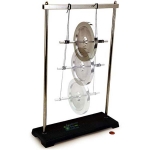
The Colliding Steel Spheres by Scientifc Equipment are an educational physics laboratory apparatus designed for demonstrating collision, momentum transfer, conservation of momentum, kinetic energy, impulse, elastic collision, and motion analysis. This product is ideal for school science laboratories, college physics labs, STEM classrooms, mechanics lessons, teacher demonstrations, student practicals, and science project activities.
This apparatus helps students observe how steel spheres behave before, during, and after impact. By using spherical steel balls in controlled collision experiments, learners can study energy transfer, direction of motion, impact force, rebound behavior, and the relationship between mass, velocity, and momentum.
Product Description
Colliding Steel Spheres are commonly used in physics classrooms to demonstrate the principles of collision mechanics. When one sphere strikes another, part or most of its momentum and kinetic energy is transferred to the second sphere, depending on the setup and nature of the collision. This makes the apparatus useful for explaining elastic collisions, impulse, action-reaction forces, and Newton’s laws of motion.
The Scientifc Equipment Colliding Steel Spheres are designed for supervised educational use. Depending on product configuration, the set may include polished steel spheres, suspension cords, support frame, alignment hooks, mounting base, activity guide, and experiment worksheet. It can be used for classroom demonstrations, practical experiments, and STEM-based motion investigations.
Key Features
- Educational physics apparatus for collision and momentum demonstrations.
- Helps demonstrate conservation of momentum and transfer of kinetic energy.
- Useful for studying elastic collision, impulse, rebound, and Newton’s laws of motion.
- Steel spheres provide clear and visible collision effects for classroom learning.
- Suitable for mechanics lessons, STEM activities, teacher demonstrations, and student practicals.
- Encourages prediction, observation, measurement, comparison, and data recording.
- May include support frame, suspension cords, hooks, and activity guide depending on product configuration.
- Reusable apparatus for repeated laboratory and classroom experiments.
- Designed for supervised educational demonstration use.
Product Specifications
|
Product Name |
Colliding Steel Spheres |
|
Brand |
Scientifc Equipment |
|
Product Type |
Educational Physics Collision and Momentum Demonstration Apparatus |
|
Application |
Collision Study, Momentum Transfer, Energy Transfer Demonstration, Elastic Collision Experiment, Mechanics Practical, and STEM Learning |
|
Working Principle |
Steel Spheres Transfer Momentum and Kinetic Energy During Impact, Allowing Students to Observe Collision Behavior and Motion Changes |
|
Possible Components |
Steel Spheres, Suspension Cords, Support Frame, Alignment Hooks, Base Stand, Activity Sheet, and Instruction Manual Depending on Product Configuration |
|
Possible Material |
Polished Steel Spheres with Metal, Plastic, or Wooden Support Parts Depending on Apparatus Design |
|
Demonstration Concepts |
Momentum, Conservation of Momentum, Kinetic Energy, Elastic Collision, Impulse, Impact Force, Rebound, Inertia, and Newton’s Laws of Motion |
|
Educational Use |
Physics Practical, Mechanics Lesson, Motion Experiment, Teacher Demonstration, STEM Activity, Science Fair Project, and Laboratory Skill Training |
|
Suitable For |
Schools, Colleges, Science Laboratories, Physics Labs, STEM Classrooms, Science Clubs, and Student Project Work |
|
Learning Topics |
Collision Physics, Energy Transfer, Momentum Transfer, Force, Motion, Velocity, Mass, Impact, and Scientific Observation |
|
Operation |
Manual Release, Collision Observation, Measurement, Comparison, and Data Recording Under Teacher or Laboratory Instructor Supervision |
|
Important Note |
For Educational Demonstration and Classroom Learning Use Only; Not for Industrial Impact Testing or Precision Research Applications |
How to Use
- Place the Colliding Steel Spheres apparatus on a clean, flat, and stable laboratory table.
- Check that the spheres, support frame, cords, hooks, and base are properly aligned and secure.
- Ensure the spheres are hanging freely and touching or aligned correctly according to the experiment setup.
- Pull one steel sphere gently to one side while keeping the cord straight.
- Release the sphere without pushing it and allow it to strike the other sphere or group of spheres.
- Observe how momentum and energy are transferred through the collision.
- Repeat the demonstration by changing the release height or number of spheres involved if the apparatus design allows.
- Record observations such as rebound height, motion direction, number of moving spheres, and visible energy transfer.
- Discuss the results in relation to conservation of momentum, kinetic energy, impulse, and Newton’s laws of motion.
- After use, stop all moving spheres carefully and return them to their resting position.
- Store the apparatus safely in a clean and dry place after the activity.
Safety and Handling Instructions
- Use only under teacher, laboratory instructor, or trained adult supervision.
- Keep fingers, face, loose clothing, and fragile objects away from the moving spheres.
- Do not pull the spheres too far back or release them with excessive force.
- Do not allow students to strike the spheres with hands, tools, or other objects.
- Ensure the apparatus is placed on a stable surface before use.
- Check suspension cords, hooks, and frame stability before each demonstration.
- Do not use damaged, loose, cracked, or unstable components.
- Handle steel spheres carefully, as they may be heavy and can cause injury if dropped.
- Store away from moisture, dust, chemicals, heat, and rough handling.
Educational Applications
- Demonstrating transfer of momentum during collisions.
- Explaining conservation of momentum in a visible way.
- Studying kinetic energy transfer between steel spheres.
- Observing elastic collision and rebound behavior.
- Teaching impulse, impact force, inertia, and Newton’s laws of motion.
- Supporting STEM activities, mechanics practicals, and motion investigations.
- Encouraging prediction, observation, measurement, graphing, and scientific discussion.
- Useful for science fairs, classroom demonstrations, and student project work.
Why Choose Scientifc Equipment Colliding Steel Spheres?
The Scientifc Equipment Colliding Steel Spheres make collision physics clear, practical, and engaging for students. The apparatus allows teachers to demonstrate momentum transfer and energy conservation through a simple visual experiment, while students gain hands-on experience in observation, comparison, scientific reasoning, and mechanics-based learning.
FAQ
- What are Colliding Steel Spheres used for?
Colliding Steel Spheres are used for demonstrating collision, momentum transfer, energy transfer, elastic collision, impulse, rebound motion, and Newton’s laws of motion in physics lessons.
- Is this apparatus suitable for school laboratories?
Yes, it is suitable for school science laboratories, college physics labs, STEM classrooms, mechanics lessons, teacher demonstrations, and student practical activities.
- What physics concept does this product demonstrate?
It mainly demonstrates conservation of momentum, kinetic energy transfer, elastic collision, impulse, action-reaction forces, and motion behavior after impact.
- How do the steel spheres transfer momentum?
When one sphere strikes another, the impact transfers momentum and energy through the contact point, causing another sphere to move or rebound depending on the setup.
- Can students use the apparatus directly?
Students can use the apparatus under teacher or laboratory instructor supervision. They should release the spheres gently and keep hands away from the collision area.
- Can this product be used for science fair demonstrations?
Yes, Colliding Steel Spheres are suitable for science fairs, STEM demonstrations, classroom activities, and project-based learning related to motion and collisions.
- Is this product used for industrial impact testing?
No, this product is designed for educational demonstration and classroom learning only. It is not intended for industrial impact testing or precision research applications.
- How should Colliding Steel Spheres be stored?
After use, stop all sphere motion, check the cords and frame, clean the components gently if needed, and store the apparatus in a clean, dry, and safe place away from moisture, dust, heat, and rough handling.
SEO Keywords
Colliding Steel Spheres, Scientifc Equipment Colliding Steel Spheres, steel sphere collision apparatus, momentum transfer demonstration, elastic collision apparatus, conservation of momentum kit, physics collision experiment, Newton laws demonstration, kinetic energy transfer apparatus, STEM mechanics equipment, school physics lab apparatus, educational science equipment.
SEO Meta Title
Colliding Steel Spheres – Scientifc Equipment Physics Collision Apparatus
SEO Meta Description
Buy Colliding Steel Spheres by Scientifc Equipment for school physics labs, STEM classrooms, momentum transfer experiments, elastic collision demonstrations, kinetic energy study, Newton’s laws activities, mechanics practicals, and hands-on classroom learning.
Google E-E-A-T Focused Content
This product content is prepared to support teachers, laboratory suppliers, educational institutions, physics instructors, STEM coordinators, science clubs, students, and educational buyers with clear product information, practical specifications, usage guidance, safety instructions, and helpful FAQs. The content focuses on accurate educational mechanics applications, safe supervised use, proper collision experiment setup, observation-based learning, momentum transfer concepts, and trustworthy product guidance while clearly stating that the product is for educational demonstration and classroom learning use only.
.jpg)
.jpg)
.jpg)
.jpg)
.jpg)