Economy Switch Manufacturer,Supplier and Exporter in India
.jpg)
Product Code : SCL-PLE-11384
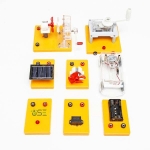
Scientifc Equipment Economy Switch is a simple and practical electrical circuit component designed for school science laboratories, physics practicals, STEM classrooms, electronics activities, and basic electricity experiments. It is used to open and close low-voltage circuits, helping students understand current flow, circuit control, switch operation, and the difference between open and closed circuits.
The Economy Switch is suitable for classroom demonstrations and student practical activities where a basic, affordable, and easy-to-use switch is required. It can be used with batteries, bulbs, LEDs, buzzers, motors, lamp boards, battery holders, and other low-voltage educational circuit components.
Product Description
The Economy Switch by Scientifc Equipment is an educational switch used to control the flow of electricity in simple circuits. When the switch is turned on or closed, the circuit is completed and current flows through the connected component. When the switch is turned off or opened, the circuit is broken and current flow stops.
This switch is useful for teaching students how electrical circuits are controlled in real-life applications. It provides a clear and simple way to demonstrate open circuits, closed circuits, switch function, current flow, and safe low-voltage circuit operation.
Scientifc Equipment Economy Switch is ideal for school-level electricity experiments, STEM project models, circuit building kits, science fair demonstrations, and introductory electronics activities.
Key Features
- Brand: Scientifc Equipment
- Simple Circuit Control: Used to open and close low-voltage electrical circuits.
- Economy Design: Suitable for classroom use, student experiments, and basic circuit kits.
- Educational Use: Ideal for physics labs, electronics lessons, STEM activities, and general science practicals.
- Easy Operation: Helps students clearly understand switch function and current control.
- Compatible with Basic Components: Can be used with bulbs, LEDs, buzzers, batteries, motors, and connecting wires.
- Reusable Apparatus: Suitable for repeated school and college practical use under supervision.
- Hands-On Learning Tool: Helps students build and test simple circuits practically.
Product Specifications
|
Product Name |
Economy Switch |
|
Brand |
Scientifc Equipment |
|
Product Type |
Educational electrical circuit switch |
|
Primary Use |
Opening and closing low-voltage circuits in classroom experiments |
|
Working Principle |
Completes or breaks the electrical path to control current flow |
|
Connection Type |
Wire terminals, clips, screw posts, or connection points as per supplied model configuration |
|
Compatible Components |
Battery holders, bulbs, LEDs, buzzers, miniature motors, lamp boards, connecting wires, and circuit boards |
|
Power Use |
Suitable for low-voltage educational circuits as per experiment requirement |
|
Subject Use |
Physics, electricity, electronics, general science, engineering basics, and STEM education |
|
Demonstration Topics |
Open circuit, closed circuit, current flow, switch operation, circuit control, polarity, series circuits, and parallel circuits |
|
Application |
Classroom demonstrations, school practicals, electricity experiments, electronics projects, STEM activities, and science fair models |
|
Suitable For |
Schools, colleges, physics laboratories, electronics labs, STEM labs, science classrooms, and educational institutions |
|
Usage Mode |
Teacher-led demonstration and supervised student practical use |
|
Packaging |
Standard educational laboratory supply packaging |
How to Use Economy Switch
- Place the Economy Switch on a clean, dry, and stable laboratory table.
- Keep the switch in the off or open position before making connections.
- Connect one wire from the battery or low-voltage power source to one terminal of the switch.
- Connect another wire from the second terminal of the switch to a component such as a bulb, LED, buzzer, or motor.
- Complete the circuit by connecting the remaining component terminal back to the power source.
- Check that all wires and connections are secure before switching on the circuit.
- Turn the switch on or close it to complete the circuit and allow current to flow.
- Observe the connected component operating, such as a bulb glowing or buzzer sounding.
- Turn the switch off or open it to break the circuit and stop current flow.
- Record observations in the practical notebook or worksheet.
- After use, disconnect the power source and store the switch safely in a dry place.
Educational Applications
- Demonstrating open and closed electrical circuits
- Teaching the function of a switch in a circuit
- Controlling bulbs, LEDs, buzzers, motors, and other low-voltage components
- Building simple battery-powered circuits
- Supporting series and parallel circuit experiments
- Explaining current flow and circuit interruption
- Using in STEM models, electronics activities, and science fair projects
- Helping students develop practical circuit-building and troubleshooting skills
Why Choose Scientifc Equipment Economy Switch?
Scientifc Equipment provides practical educational science apparatus designed for classroom demonstrations, laboratory experiments, and STEM-based learning. The Economy Switch is suitable for institutions that need a simple, affordable, and reusable switch for teaching basic electricity and circuit control.
- Suitable for school and college science laboratories
- Useful for physics, electricity, electronics, and STEM practicals
- Simple design for easy classroom demonstration
- Helps students understand open circuits, closed circuits, and switch operation
- Compatible with common low-voltage circuit components
- Suitable for institutional procurement and science lab setup
Care and Safety Instructions
- Use the Economy Switch only under teacher or laboratory instructor supervision.
- Use only with suitable low-voltage educational circuits.
- Do not connect the switch directly to mains electricity.
- Keep the switch in the off position while making or changing connections.
- Check wires, terminals, and contacts before switching on the circuit.
- Avoid short circuits by connecting components according to the experiment diagram.
- Do not touch exposed conducting parts when the circuit is powered.
- Keep the switch clean, dry, and away from water, moisture, heat, and corrosive chemicals.
- Replace damaged switches, loose terminals, or broken wires before use.
- Store the switch safely in a dry laboratory cabinet after practical work.
SEO Title
Economy Switch for School Science Lab – Scientifc Equipment
Meta Description
Buy Scientifc Equipment Economy Switch for school science labs, STEM classrooms, physics practicals, open and closed circuit demonstrations, basic electricity experiments, and low-voltage circuit activities.
SEO Keywords
Economy Switch, Scientifc Equipment Economy Switch, School Lab Switch, Physics Lab Electrical Switch, Basic Circuit Switch, STEM Electricity Switch, Educational Circuit Switch, Open Closed Circuit Switch, Low Voltage Switch for Students, Science Lab Electrical Apparatus.
FAQ – Economy Switch
- What is an Economy Switch used for?
An Economy Switch is used to open and close low-voltage electrical circuits in school science experiments, physics practicals, STEM activities, and basic electronics projects.
- Is this switch suitable for school laboratories?
Yes, Scientifc Equipment Economy Switch is suitable for school science laboratories, physics practicals, electronics classrooms, STEM labs, and supervised student activities.
- How does an Economy Switch work?
The switch works by completing or breaking the electrical path. When closed, current flows through the circuit. When opened, current flow stops.
- Which concepts can be taught using this switch?
This switch can be used to teach open circuits, closed circuits, current flow, switch operation, circuit control, series circuits, parallel circuits, and basic electrical safety.
- Can students use the Economy Switch directly?
Yes, students can use it under teacher or laboratory instructor supervision with suitable low-voltage circuit connections.
- What components can be connected with this switch?
It can be connected with batteries, bulbs, LEDs, buzzers, miniature motors, lamp boards, resistors, circuit boards, and other low-voltage educational components.
- Can it be used in series and parallel circuit experiments?
Yes, the Economy Switch can be used to control current flow in series and parallel circuit arrangements depending on the experiment setup.
- Why is a switch important in an electrical circuit?
A switch is important because it controls whether the circuit is complete or incomplete, allowing users to turn connected components on or off safely.
- What safety precautions should be followed?
Use only low-voltage power, avoid short circuits, do not connect to mains electricity, keep the switch off while wiring, and check all connections before use.
- How should the Economy Switch be maintained?
Keep the switch clean and dry, protect terminals from rust or damage, avoid excessive force, inspect connections regularly, and store it safely after use.
- Is this product useful for STEM education?
Yes, it supports STEM education by helping students build working circuits, observe current control, and understand open and closed circuit concepts through hands-on learning.
Conclusion
Scientifc Equipment Economy Switch is a practical educational circuit component for teaching basic electricity, open circuits, closed circuits, current flow, and switch operation. Its simple and reusable design makes it suitable for school laboratories, STEM classrooms, physics practicals, electronics activities, science fair projects, and institutional science lab setups.
.jpg)
.jpg)
.jpg)
.jpg)