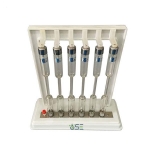
Friction Box Manufacturer,Supplier and Exporter in India
.jpg)
Product Code : SCL-PLE-11404
Scientifc Equipment Friction Box is an educational physics laboratory apparatus designed to demonstrate frictional force, static friction, sliding friction, limiting friction, surface resistance, normal reaction, and the effect of load on friction. It is suitable for school science laboratories, STEM classrooms, physics practicals, mechanics lessons, and teacher-led classroom demonstrations.
The Friction Box helps students understand how different surfaces resist motion and why more force is required to move heavier objects. It is commonly used with a spring balance, weights, string, and different surfaces to compare friction under different experimental conditions.
Product Description
The Friction Box by Scientifc Equipment is a practical mechanics apparatus used to study friction between two surfaces in contact. The box is generally provided with a hook or attachment point so that it can be pulled using a spring balance or string during classroom experiments.
Students can place the friction box on a smooth or rough surface and pull it slowly to observe the force required to start motion and maintain uniform motion. Additional weights may be placed on or inside the box, depending on the supplied model configuration, to study how load affects frictional force.
Scientifc Equipment Friction Box is useful for teaching static friction, kinetic friction, limiting friction, coefficient of friction, surface roughness, normal force, and real-life applications of friction such as walking, braking, gripping, tyres, belts, and machine parts.
Key Features
- Brand: Scientifc Equipment
- Friction Demonstration Tool: Designed to demonstrate friction between surfaces.
- Physics Lab Suitable: Useful for mechanics, force, motion, and friction experiments.
- Hook Attachment: Allows connection with a spring balance or string for pulling experiments.
- Load Variation Study: Helps students observe how added weight affects friction.
- Surface Comparison: Suitable for comparing friction on smooth and rough surfaces.
- Hands-On STEM Learning: Supports practical observation, measurement, and data recording.
- Reusable Apparatus: Suitable for repeated teacher-led and supervised student practicals.
Product Specifications
|
Product Name |
Friction Box |
|
Brand |
Scientifc Equipment |
|
Product Type |
Educational friction and mechanics demonstration apparatus |
|
Primary Use |
Demonstrating frictional force, static friction, sliding friction, and effect of load on friction |
|
Working Principle |
Friction opposes relative motion between two surfaces in contact and depends on surface nature and normal force |
|
Main Components |
Friction box, hook or attachment point, contact surface, and accessories as per supplied model configuration |
|
Compatible Accessories |
Spring balance, string, slotted weights, weight hanger, friction board, different surface sheets, and measuring scale |
|
Subject Use |
Physics, mechanics, force and motion, general science, and STEM education |
|
Demonstration Topics |
Static friction, sliding friction, limiting friction, coefficient of friction, surface roughness, normal reaction, applied force, and motion resistance |
|
Application |
Classroom demonstrations, school practicals, mechanics experiments, STEM activities, science projects, and laboratory learning |
|
Suitable For |
Schools, colleges, physics laboratories, STEM labs, science classrooms, and educational institutions |
|
Usage Mode |
Teacher-led demonstration and supervised student practical use |
|
Packaging |
Standard educational laboratory supply packaging |
How to Use Friction Box
- Place the Friction Box on a clean, dry, and stable surface or friction board.
- Attach a spring balance or string to the hook of the friction box.
- Pull the box slowly and steadily in a horizontal direction.
- Record the spring balance reading when the box just begins to move to study limiting friction.
- Continue pulling the box at uniform speed and record the reading for sliding friction.
- Add suitable weights on or inside the box, if the experiment requires load variation.
- Repeat the experiment and compare the force required with different loads.
- Place the box on different surfaces such as smooth, rough, wooden, or paper-covered surfaces to compare friction.
- Record all observations such as surface type, load, applied force, and frictional force in the practical notebook.
- Discuss how friction changes with load and surface texture.
- After use, remove all weights and accessories and store the friction box safely.
Educational Applications
- Demonstrating static friction and sliding friction
- Teaching limiting friction and coefficient of friction
- Studying the effect of load on frictional force
- Comparing friction on smooth and rough surfaces
- Explaining normal reaction and surface resistance
- Demonstrating resistance to motion in practical situations
- Using with spring balances for force measurement activities
- Supporting STEM projects, mechanics practicals, and science fair demonstrations
- Helping students understand real-life uses of friction in brakes, tyres, walking, belts, and gripping surfaces
Why Choose Scientifc Equipment Friction Box?
Scientifc Equipment provides practical educational science apparatus designed for classroom demonstrations, student experiments, and STEM-based learning. The Friction Box helps students understand friction through direct observation, measurement, comparison, and hands-on practical work.
- Suitable for school and college physics laboratories
- Useful for mechanics, force, motion, and friction demonstrations
- Simple setup for clear classroom explanation
- Helps students compare friction under different load and surface conditions
- Compatible with common laboratory accessories such as spring balances, strings, weights, and friction boards
- Supports activity-based STEM learning and practical calculation work
- Suitable for institutional procurement and science lab setup
Care and Safety Instructions
- Use the Friction Box only under teacher or laboratory instructor supervision.
- Place the apparatus on a stable and level surface before use.
- Do not overload the friction box beyond the recommended classroom experiment limit.
- Pull the box slowly and steadily; do not jerk the string or spring balance.
- Make sure weights are placed securely before pulling the box.
- Keep fingers away from moving parts, strings, and hanging weights during experiments.
- Check the hook, string, spring balance, and surface condition before use.
- Keep the box clean, dry, and free from dust after practical work.
- Store all accessories safely to prevent loss or damage.
- Store the friction box in a dry laboratory cabinet after use.
SEO Title
Friction Box for School Physics Lab – Scientifc Equipment
Meta Description
Buy Scientifc Equipment Friction Box for school physics labs, STEM classrooms, friction force experiments, static and sliding friction demonstrations, load effect studies, and mechanics practicals.
SEO Keywords
Friction Box, Scientifc Equipment Friction Box, School Lab Friction Box, Physics Lab Friction Box, Friction Demonstration Apparatus, Static Friction Experiment, Sliding Friction Box, Coefficient of Friction Apparatus, STEM Mechanics Equipment, Educational Physics Friction Box.
FAQ – Friction Box
- What is a Friction Box used for?
A Friction Box is used to demonstrate static friction, sliding friction, limiting friction, surface resistance, and the effect of load on frictional force.
- Is the Friction Box suitable for school science laboratories?
Yes, Scientifc Equipment Friction Box is suitable for school science labs, physics practicals, STEM classrooms, mechanics demonstrations, and supervised student experiments.
- Which physics concepts can be taught using this apparatus?
This apparatus can be used to teach frictional force, static friction, kinetic friction, limiting friction, normal reaction, applied force, surface roughness, and motion resistance.
- Can students use the Friction Box directly?
Yes, students can use the apparatus under teacher or laboratory instructor supervision after learning the correct setup and safety instructions.
- How does load affect friction?
Increasing the load generally increases the normal force between the surfaces, which can increase the frictional force needed to move the box.
- How does surface type affect friction?
Rough surfaces usually create more friction than smooth surfaces because surface irregularities resist motion more strongly.
- Can the Friction Box be used with a spring balance?
Yes, the Friction Box can be attached to a spring balance to measure the force required to start and maintain motion.
- Can this apparatus help calculate coefficient of friction?
Yes, with suitable measurements of frictional force and normal force, students can calculate the coefficient of friction during physics practicals.
- Does the Friction Box require electricity?
No, the Friction Box is a mechanical demonstration apparatus and does not require electricity for normal classroom use.
- What safety precautions should be followed?
Use the apparatus on a stable surface, avoid overloading, pull slowly, secure weights properly, and keep fingers away from moving strings, weights, and blocks.
- How should the Friction Box be maintained?
Keep the box clean and dry, check the hook and contact surfaces regularly, avoid rough handling, and store the apparatus safely after use.
- Is this product useful for STEM education?
Yes, it supports STEM education by helping students observe friction, force, motion, surface resistance, and load effects through hands-on experiments.
Conclusion
Scientifc Equipment Friction Box is a useful educational mechanics apparatus for teaching frictional force, static friction, sliding friction, limiting friction, normal reaction, surface resistance, and load effect. Its simple design and measurable experiment format make it suitable for school laboratories, STEM classrooms, physics practicals, mechanics experiments, science projects, and institutional science lab setups.
.jpg)
.jpg)
.jpg)
 (1).png)
.jpg)