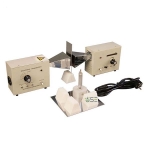
Gold Leaf Electroscope Manufacturer,Supplier and Exporter in India
 (1).png)
Product Code : SCL-PLE-11360
Scientifc Equipment Gold Leaf Electroscope is an educational physics laboratory apparatus designed to detect the presence of electric charge and demonstrate the principles of static electricity, electrostatic induction, charge distribution, and repulsion between like charges. It is suitable for school physics laboratories, STEM classrooms, general science practicals, and teacher-led demonstrations.
The apparatus helps students observe how electric charges behave when a charged object is brought near or touched to the metal cap of the electroscope. The movement or divergence of the thin gold leaves provides a clear visual indication of electric charge, making abstract electrostatic concepts easier to understand through practical observation.
Product Description
The Gold Leaf Electroscope by Scientifc Equipment is a classic physics instrument used for detecting and demonstrating electric charge. It generally consists of a metal cap or disc, conducting rod, thin gold leaves or metal leaves, insulating support, and a protective glass case to prevent air movement from disturbing the leaves.
When a charged object is brought near the metal cap, charges inside the electroscope rearrange due to electrostatic induction. When charge is transferred to the electroscope, the leaves receive the same type of charge and repel each other, causing them to separate. This visible leaf movement helps students understand charge detection, charging by contact, charging by induction, and discharge.
Scientifc Equipment Gold Leaf Electroscope is suitable for experiments involving static electricity, charged rods, induction, earthing, conductors, insulators, and the behaviour of positive and negative charges in physics education.
Key Features
- Brand: Scientifc Equipment
- Classic Electrostatics Apparatus: Designed to detect and demonstrate electric charge.
- Gold Leaf / Metal Leaf Movement: Provides a visible indication of charge presence and repulsion.
- Protective Case: Helps protect the leaves from air currents and accidental disturbance.
- Educational Use: Suitable for physics labs, STEM classrooms, and static electricity demonstrations.
- Concept-Based Learning: Helps explain induction, conduction, repulsion, discharge, and earthing.
- Reusable Apparatus: Suitable for repeated classroom and laboratory use under supervision.
- Teacher-Friendly Demonstration: Supports clear observation of electrostatic effects during practical lessons.
Product Specifications
|
Product Name |
Gold Leaf Electroscope |
|
Brand |
Scientifc Equipment |
|
Product Type |
Educational electrostatics demonstration apparatus |
|
Primary Use |
Detecting electric charge and demonstrating static electricity principles |
|
Working Principle |
Electrostatic induction and repulsion between like charges |
|
Main Components |
Metal cap or disc, conducting rod, gold leaves or metal leaves, insulating support, and protective case as per supplied model configuration |
|
Subject Use |
Physics, electrostatics, general science, electricity, and STEM education |
|
Demonstration Topics |
Static electricity, electric charge detection, induction, conduction, repulsion, earthing, discharge, conductors, and insulators |
|
Compatible Accessories |
Glass rod, ebonite rod, fur, silk cloth, charged objects, and grounding wire as per experiment requirement |
|
Application |
Classroom demonstrations, school practicals, STEM activities, electrostatics experiments, and science projects |
|
Suitable For |
Schools, colleges, physics laboratories, STEM labs, science classrooms, and educational institutions |
|
Usage Mode |
Teacher-led demonstration and supervised student practical use |
|
Packaging |
Standard educational laboratory supply packaging |
How to Use Gold Leaf Electroscope
- Place the Gold Leaf Electroscope on a stable, dry, and clean laboratory table.
- Ensure the glass case is clean and the leaves are hanging freely inside the instrument.
- Rub a glass rod with silk or an ebonite rod with fur to produce static charge.
- Bring the charged rod close to the metal cap without touching it to demonstrate electrostatic induction.
- Observe the movement or separation of the leaves inside the electroscope.
- Touch the charged rod to the metal cap to transfer charge by conduction, if required by the experiment.
- Observe how the leaves diverge due to repulsion between like charges.
- Touch the metal cap with a finger or grounding wire to discharge the electroscope.
- Observe the leaves returning to their normal position after discharge.
- Record observations in the practical notebook or worksheet.
- After use, keep the electroscope covered and store it safely in a dry place.
Educational Applications
- Detecting the presence of electric charge
- Demonstrating static electricity in physics practicals
- Explaining electrostatic induction and charge redistribution
- Showing repulsion between like charges
- Demonstrating charging by contact and charging by induction
- Explaining earthing and discharge of an electroscope
- Comparing conductors and insulators in electrostatics experiments
- Using with charged glass rods, ebonite rods, fur, and silk cloth
- Supporting STEM activities, science projects, and classroom demonstrations
Why Choose Scientifc Equipment Gold Leaf Electroscope?
Scientifc Equipment provides practical educational laboratory apparatus designed for classroom demonstrations, student experiments, and STEM-based learning. The Gold Leaf Electroscope helps students observe static electricity and charge behaviour through a simple, visual, and effective demonstration method.
- Suitable for school and college physics laboratories
- Useful for electrostatics, charge detection, and induction experiments
- Provides visible leaf movement for clear classroom explanation
- Helps students connect textbook theory with real laboratory observation
- Supports activity-based STEM learning and science project work
- Suitable for institutional procurement and physics lab setup
Care and Safety Instructions
- Use the apparatus under teacher or laboratory instructor supervision.
- Handle the electroscope carefully, as the leaves are delicate.
- Do not shake, drop, or strike the instrument on hard surfaces.
- Keep the apparatus dry, as moisture can reduce electrostatic effects.
- Clean the outer case gently with a soft, dry cloth.
- Avoid touching the leaves or internal conducting parts unnecessarily.
- Keep the apparatus away from strong air currents during observation.
- Store in a dry, dust-free laboratory cabinet after use.
SEO Title
Gold Leaf Electroscope for School Physics Lab – Scientifc Equipment
Meta Description
Buy Scientifc Equipment Gold Leaf Electroscope for school physics labs, STEM classrooms, electrostatics experiments, static electricity demonstrations, charge detection, and induction practicals.
SEO Keywords
Gold Leaf Electroscope, Scientifc Equipment Gold Leaf Electroscope, School Lab Electroscope, Physics Lab Electroscope, Electrostatics Apparatus, Static Electricity Demonstration, Charge Detection Instrument, STEM Physics Apparatus, Electric Charge Experiment, Gold Leaf Electroscope for Students.
FAQ – Gold Leaf Electroscope
- What is a Gold Leaf Electroscope used for?
A Gold Leaf Electroscope is used to detect electric charge and demonstrate static electricity, electrostatic induction, charge transfer, repulsion between like charges, and discharge.
- Is this electroscope suitable for school physics laboratories?
Yes, Scientifc Equipment Gold Leaf Electroscope is suitable for school physics labs, college practical labs, STEM classrooms, and teacher-led electrostatics demonstrations.
- How does a Gold Leaf Electroscope work?
When charge is introduced or induced on the electroscope, the leaves receive similar charges and repel each other, causing visible separation or divergence.
- Which physics concepts can be taught using this apparatus?
This apparatus can be used to teach static electricity, electric charge, induction, conduction, repulsion, earthing, discharge, conductors, and insulators.
- Can students use the Gold Leaf Electroscope?
Yes, students can use it under teacher or laboratory instructor supervision. The leaves are delicate, so careful handling is required.
- Why do the leaves of the electroscope separate?
The leaves separate because they acquire the same type of electric charge and repel each other due to electrostatic repulsion.
- How can the electroscope be discharged?
The electroscope can be discharged by touching the metal cap with a finger or connecting it to earth using a grounding wire.
- Why should the electroscope be kept dry?
Moisture can allow charge to leak away from the electroscope, reducing the leaf movement and making electrostatic experiments less effective.
- What accessories can be used with this electroscope?
It can be used with charged glass rods, ebonite rods, silk cloth, fur, grounding wire, and other electrostatics accessories.
- Is this product useful for STEM education?
Yes, it supports STEM education by helping students observe electric charge, induction, repulsion, and discharge through practical hands-on demonstrations.
Conclusion
Scientifc Equipment Gold Leaf Electroscope is an important educational apparatus for teaching electrostatics, charge detection, static electricity, induction, conduction, and discharge. Its visible leaf movement provides a clear and effective classroom demonstration, making it suitable for school laboratories, STEM classrooms, college practicals, science projects, and institutional physics lab setups.
 (1).png)
.jpg)
 (1).png)
.jpg)
.jpg)