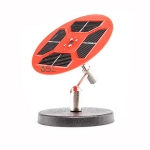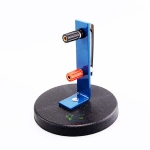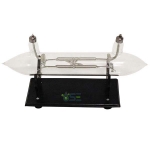
Lamp Boards Manufacturer,Supplier and Exporter in India
 (1).png)
Product Code : SCL-PLE-11378
Scientifc Equipment Lamp Boards are educational electrical circuit demonstration boards designed for school science laboratories, physics practicals, STEM classrooms, electronics activities, and basic electricity experiments. They are used to demonstrate the working of lamps in simple circuits, series circuits, parallel circuits, open circuits, closed circuits, switches, current flow, and voltage distribution.
Lamp Boards help students understand how electrical energy is converted into light energy and how circuit arrangement affects lamp brightness. These boards are suitable for teacher-led demonstrations, supervised student practicals, classroom experiments, science projects, and hands-on STEM learning.
Product Description
The Lamp Boards by Scientifc Equipment are practical classroom apparatus used to build and demonstrate electrical circuits using lamp holders and connecting terminals. The board generally includes one or more lamp holders, terminals, connecting points, switches, and a sturdy base as per supplied model configuration.
Students can connect the lamp board with a suitable low-voltage battery or DC power supply to observe lamp operation. The apparatus helps demonstrate how a complete circuit allows current to flow and light the lamp, while an open circuit stops current flow and turns the lamp off.
Scientifc Equipment Lamp Boards are useful for teaching electricity concepts such as current, voltage, resistance, polarity, switch operation, series connection, parallel connection, brightness comparison, and electrical safety in school-level physics education.
Key Features
- Brand: Scientifc Equipment
- Educational Circuit Board: Designed for demonstrating lamp-based electrical circuits.
- Simple Circuit Learning: Helps students understand open and closed circuits.
- Series and Parallel Demonstration: Useful for showing how circuit arrangement affects lamp brightness.
- STEM Suitable: Ideal for physics labs, electronics classrooms, and science practicals.
- Easy Connection Points: Allows convenient connection with batteries, switches, wires, and meters.
- Reusable Apparatus: Suitable for repeated school and college laboratory use under supervision.
- Hands-On Learning Tool: Helps students observe real electrical circuit behaviour practically.
Product Specifications
|
Product Name |
Lamp Boards |
|
Brand |
Scientifc Equipment |
|
Product Type |
Educational lamp circuit demonstration board |
|
Primary Use |
Demonstrating electrical circuits using lamps and low-voltage power sources |
|
Working Principle |
Electric current flows through a closed circuit and converts electrical energy into light energy in the lamp |
|
Main Components |
Lamp holder, lamp, connecting terminals, switch, base board, and wire connection points as per supplied model configuration |
|
Power Source |
Suitable low-voltage battery or DC power supply as per experiment requirement |
|
Connection Type |
Terminals, binding posts, clips, or wire connection points as per model configuration |
|
Subject Use |
Physics, electricity, electronics, general science, engineering basics, and STEM education |
|
Demonstration Topics |
Open circuit, closed circuit, current flow, voltage, resistance, polarity, switch operation, series circuit, parallel circuit, and lamp brightness |
|
Compatible Components |
Battery holders, connecting wires, switches, voltmeters, ammeters, multimeters, power supplies, and circuit accessories |
|
Application |
Classroom demonstrations, school practicals, STEM activities, electricity experiments, electronics projects, and science fair models |
|
Suitable For |
Schools, colleges, physics laboratories, STEM labs, electronics classrooms, and educational institutions |
|
Usage Mode |
Teacher-led demonstration and supervised student practical use |
|
Packaging |
Standard educational laboratory supply packaging |
How to Use Lamp Boards
- Place the lamp board on a clean, dry, and stable laboratory table.
- Check that the lamp, holder, terminals, switch, and connecting points are in proper condition.
- Connect the lamp board to a suitable low-voltage battery or DC power supply using connecting wires.
- Make sure the positive and negative connections are properly arranged as per the experiment requirement.
- Close the circuit using the switch or connection wire and observe the lamp glowing.
- Open the circuit by turning off the switch or disconnecting a wire and observe the lamp turning off.
- Use additional lamp boards or multiple lamps to demonstrate series and parallel circuits if required.
- Compare lamp brightness in different circuit arrangements.
- Use voltmeters or ammeters if required to measure voltage and current in the circuit.
- Record observations in the practical notebook or worksheet.
- After use, switch off the power source and disconnect all wires carefully.
- Store the lamp board safely in a clean and dry laboratory cabinet.
Educational Applications
- Demonstrating simple lamp circuits
- Teaching open and closed circuit concepts
- Explaining current flow through a complete circuit
- Showing electrical energy conversion into light energy
- Comparing lamp brightness in series and parallel circuits
- Studying the effect of switches in electrical circuits
- Using with voltmeters and ammeters for circuit measurement
- Supporting STEM projects, electronics activities, and science fair models
- Helping students develop circuit-building and troubleshooting skills
Why Choose Scientifc Equipment Lamp Boards?
Scientifc Equipment provides practical educational science apparatus designed for classroom demonstrations, laboratory experiments, and STEM-based learning. Lamp Boards help students understand electricity through direct observation of working circuits and lamp operation.
- Suitable for school and college science laboratories
- Useful for electricity, electronics, and physics practicals
- Helps students learn open circuit, closed circuit, series circuit, and parallel circuit concepts
- Supports hands-on learning of current flow, voltage, resistance, and lamp brightness
- Simple design for teacher-led demonstrations and supervised student use
- Suitable for institutional procurement and science lab setup
Care and Safety Instructions
- Use Lamp Boards only under teacher or laboratory instructor supervision.
- Use only suitable low-voltage batteries or approved educational DC power supplies.
- Do not connect the lamp board directly to mains electricity.
- Check all wires, terminals, lamp holders, and switches before use.
- Avoid short circuits by connecting wires carefully and correctly.
- Do not touch the lamp immediately after long operation, as it may become warm.
- Switch off the power source after completing the experiment.
- Keep the board away from water, moisture, dust, and corrosive chemicals.
- Replace damaged lamps, loose terminals, or broken wires before use.
- Store the apparatus in a dry laboratory cabinet after use.
SEO Title
Lamp Boards for School Science Lab – Scientifc Equipment
Meta Description
Buy Scientifc Equipment Lamp Boards for school science labs, STEM classrooms, electrical circuit experiments, series and parallel circuit demonstrations, lamp brightness studies, and physics practicals.
SEO Keywords
Lamp Boards, Scientifc Equipment Lamp Boards, School Lab Lamp Board, Physics Lab Lamp Board, Electrical Circuit Lamp Board, STEM Electricity Apparatus, Series Parallel Circuit Lamp Board, Educational Circuit Board, Lamp Circuit Demonstration Board, Science Lab Electricity Equipment.
FAQ – Lamp Boards
- What are Lamp Boards used for?
Lamp Boards are used to demonstrate simple electrical circuits, lamp operation, open and closed circuits, current flow, series circuits, parallel circuits, and brightness comparison in school science laboratories.
- Are Lamp Boards suitable for school laboratories?
Yes, Scientifc Equipment Lamp Boards are suitable for school science laboratories, physics practicals, electronics classrooms, STEM labs, and supervised student activities.
- Which concepts can be taught using Lamp Boards?
Lamp Boards can be used to teach current flow, voltage, resistance, switch operation, open circuits, closed circuits, series circuits, parallel circuits, polarity, and electrical energy conversion.
- What power source is required for Lamp Boards?
Lamp Boards should be used with a suitable low-voltage battery or educational DC power supply as per the model configuration and experiment requirement.
- Can students use Lamp Boards directly?
Yes, students can use Lamp Boards under teacher or laboratory instructor supervision with safe low-voltage electrical connections.
- Can Lamp Boards demonstrate series and parallel circuits?
Yes, Lamp Boards can be used individually or with additional lamps and connecting wires to demonstrate series and parallel circuit arrangements.
- Why does lamp brightness change in different circuits?
Lamp brightness changes because the voltage and current available to each lamp can vary depending on whether the lamps are connected in series or parallel.
- Can meters be used with Lamp Boards?
Yes, voltmeters, ammeters, and multimeters can be used with Lamp Boards to measure voltage, current, and circuit behaviour during experiments.
- What safety precautions should be followed?
Use only low-voltage power, avoid short circuits, do not connect to mains electricity, check all connections before use, and switch off the circuit after the experiment.
- How should Lamp Boards be maintained?
Keep the board clean and dry, check wires and terminals regularly, replace damaged lamps or loose parts, and store the apparatus safely after practical work.
- Are Lamp Boards useful for STEM education?
Yes, Lamp Boards support STEM education by helping students build working circuits, observe lamp brightness, understand current flow, and compare different circuit arrangements through hands-on learning.
Conclusion
Scientifc Equipment Lamp Boards are practical educational circuit apparatus for teaching electricity, lamp operation, open and closed circuits, current flow, switch operation, and series-parallel circuit behaviour. Their classroom-friendly design makes them suitable for school laboratories, STEM classrooms, physics practicals, electronics activities, science fair projects, and institutional science lab setups.
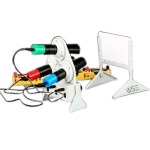
 (1).png)
.jpg)
 (1).png)