
LED Array Manufacturer,Supplier and Exporter in India
.jpg)
Product Code : SCL-PLE-11516
Scientifc Equipment LED Array is an educational electronics and physics laboratory apparatus designed to demonstrate light-emitting diode operation, circuit connections, polarity, current flow, voltage drop, series and parallel arrangements, brightness comparison, and semiconductor light output. It is suitable for school science laboratories, college physics labs, electronics labs, STEM classrooms, electrical circuit practicals, and teacher-led demonstrations.
This LED Array helps students understand how multiple LEDs can be arranged and powered in a circuit. It provides a clear visual demonstration of electrical energy conversion into light energy and supports practical learning of electronics, circuit design, resistance, current limiting, and energy-efficient lighting technology.
Product Description
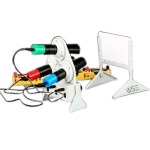
The LED Array by Scientifc Equipment is a practical classroom and laboratory teaching aid used for demonstrating the behaviour of light-emitting diodes in simple and advanced circuit activities. The apparatus generally consists of multiple LEDs mounted on a board, connecting terminals, resistors, switches, sockets, or circuit points as per supplied model configuration.
During experiments, students can connect the LED array to a suitable low-voltage DC power supply and observe how LEDs glow when connected with correct polarity. The array can be used to compare series and parallel circuits, study brightness changes, observe current distribution, and understand the importance of current-limiting resistors in LED circuits.
Scientifc Equipment LED Array is useful for teaching semiconductor devices, diode polarity, forward bias, reverse bias, voltage drop, current control, circuit continuity, energy conversion, and STEM-based electronics learning.
Key Features
- Brand: Scientifc Equipment
- Educational Electronics Apparatus: Designed for demonstrating LED operation and circuit behaviour.
- Multiple LED Arrangement: Helps students observe light output from an array of LEDs.
- Polarity Demonstration: Supports learning of anode, cathode, forward bias, and reverse bias concepts.
- Series and Parallel Circuit Study: Useful for comparing brightness, voltage, and current in different connections.
- Visual Circuit Learning: Glowing LEDs provide clear indication of current flow and circuit completion.
- STEM Classroom Suitable: Ideal for physics, electronics, electricity, and technology lessons.
- Reusable Laboratory Apparatus: Suitable for repeated supervised classroom and laboratory use.
Product Specifications
|
Product Name |
LED Array |
|
Brand |
Scientifc Equipment |
|
Product Type |
Educational LED circuit and electronics demonstration apparatus |
|
Primary Use |
Demonstrating LED operation, polarity, current flow, brightness comparison, and circuit connections |
|
Working Principle |
LEDs emit light when forward-biased and supplied with suitable current through a safe low-voltage circuit |
|
Main Components |
LEDs, circuit board or mounting panel, terminals, resistors, switches, connectors, and accessories as per supplied configuration |
|
LED Type |
Standard LEDs, coloured LEDs, high-brightness LEDs, or mixed LED arrangement as per supplied model configuration |
|
Power Requirement |
Low-voltage DC power supply or battery arrangement as per supplied model configuration |
|
Connection Type |
Series, parallel, or fixed array connection as per supplied configuration |
|
Observation Type |
LED glow, brightness variation, polarity effect, circuit continuity, and current path demonstration |
|
Compatible Accessories |
DC power supply, battery holder, connecting wires, switches, resistors, ammeter, voltmeter, multimeter, and laboratory worksheet |
|
Subject Use |
Physics, electronics, electricity, semiconductor devices, circuit design, and STEM education |
|
Demonstration Topics |
LED operation, diode polarity, forward bias, reverse bias, voltage drop, current limiting, series circuits, parallel circuits, and energy conversion |
|
Application |
Classroom demonstrations, school practicals, college electronics labs, circuit experiments, STEM projects, and science laboratory training |
|
Suitable For |
Schools, colleges, physics laboratories, electronics laboratories, electrical science labs, STEM labs, and educational institutions |
|
Usage Mode |
Teacher-led demonstration and supervised student practical use |
|
Packaging |
Standard educational laboratory packaging or protective storage box as per supplied configuration |
How to Use LED Array
- Place the LED Array on a clean, dry, stable, and level laboratory table.
- Check the LEDs, terminals, resistors, switches, and connecting points before use.
- Identify the positive and negative terminals of the LED array or circuit board.
- Connect the LED Array to a suitable low-voltage DC power supply or battery arrangement.
- Use connecting wires and switches as required by the experiment setup.
- Switch on the power and observe which LEDs glow.
- Reverse the polarity only if instructed by the teacher and observe the change in LED operation.
- Compare LED brightness in series and parallel arrangements where the model supports such experiments.
- Use an ammeter or multimeter to measure current if required.
- Use a voltmeter or multimeter to measure voltage across the LED or LED group.
- Record observations, circuit diagrams, readings, brightness changes, and conclusions in the practical notebook.
- Switch off the power supply after completing the experiment.
- Disconnect wires carefully and store the apparatus safely after use.
Educational Applications
- Demonstrating light-emitting diode operation
- Studying LED polarity and forward bias
- Comparing LED brightness in different circuit arrangements
- Teaching series and parallel LED circuits
- Understanding voltage drop across semiconductor devices
- Demonstrating current flow and circuit continuity
- Explaining the role of resistors in LED protection
- Introducing energy-efficient lighting and semiconductor technology
- Supporting STEM projects, electronics experiments, and circuit-building activities
Why Choose Scientifc Equipment LED Array?
Scientifc Equipment provides practical educational science apparatus for schools, colleges, electronics laboratories, and STEM learning environments. The LED Array helps students understand electronic circuits through visible output, simple connections, and measurement-based practical activities.
- Suitable for school and college physics and electronics laboratories
- Useful for LED operation, polarity, voltage, current, and circuit experiments
- Provides clear visual indication of circuit behaviour
- Supports hands-on learning of series and parallel connections
- Compatible with common laboratory power supplies, meters, wires, and switches
- Reusable apparatus suitable for repeated supervised practical work
- Suitable for institutional procurement and science lab setup
E-E-A-T Product Trust Notes
- Educational Experience: Designed for repeated classroom and laboratory use in electricity, electronics, and semiconductor experiments.
- Practical Expertise: Supports standard science concepts such as LED polarity, current flow, voltage drop, resistance, circuit continuity, and energy conversion.
- Authoritative Lab Use: Suitable for schools, colleges, STEM labs, physics labs, electronics labs, and electrical science laboratories.
- Trustworthy Learning: Encourages supervised, low-voltage, observation-based experiments with clear visual and measurable outcomes.
Care and Safety Instructions
- Use the LED Array only under teacher or laboratory instructor supervision.
- Use only the recommended low-voltage DC power supply or battery arrangement.
- Do not connect the LED Array directly to mains electricity.
- Do not exceed the rated voltage or current of the supplied model.
- Use suitable current-limiting resistors where required.
- Switch off power before changing wires or adjusting circuit connections.
- Do not short-circuit the terminals or bypass safety components.
- Avoid looking directly at very bright LEDs for long periods.
- Keep the apparatus away from water, moisture, corrosive chemicals, dust, and excessive heat.
- Store the LED Array in a dry and safe laboratory cabinet after use.
SEO Title
LED Array for School Physics and Electronics Lab – Scientifc Equipment
Meta Description
Buy Scientifc Equipment LED Array for school physics labs, electronics practicals, LED circuit demonstrations, polarity experiments, series and parallel circuits, voltage drop study, current flow observation, and STEM laboratory learning.
SEO Keywords
LED Array, Scientifc Equipment LED Array, School Lab LED Array, Physics Lab LED Array, Electronics Lab LED Array, LED Circuit Demonstrator, LED Polarity Apparatus, Series Parallel LED Circuit, Semiconductor Device Demonstrator, STEM Electronics Equipment.
FAQ – LED Array
- What is an LED Array used for?
An LED Array is used to demonstrate LED operation, circuit continuity, polarity, current flow, voltage drop, brightness comparison, and series or parallel circuit behaviour.
- Is this LED Array suitable for school and college laboratories?
Yes, Scientifc Equipment LED Array is suitable for school science labs, college physics labs, electronics labs, STEM classrooms, and supervised student practicals.
- Which physics and electronics concepts can be taught using this apparatus?
It can be used to teach diode polarity, forward bias, reverse bias, current flow, voltage drop, resistance, series circuits, parallel circuits, and electrical energy conversion into light.
- Does the LED Array require electricity?
Yes, it requires a suitable low-voltage DC power supply or battery arrangement as per the supplied model configuration.
- Can it be connected directly to mains electricity?
No, the LED Array should never be connected directly to mains electricity. It should be used only with a recommended low-voltage DC source.
- Why is polarity important in LED circuits?
LEDs conduct and glow mainly in one direction when forward-biased. If connected in reverse polarity, the LED may not glow and may be damaged if excessive voltage is applied.
- Why are resistors used with LEDs?
Resistors limit current through LEDs and help protect them from overheating or damage due to excessive current.
- Can students use the LED Array directly?
Students can use the apparatus under teacher or laboratory instructor supervision after learning correct wiring, polarity, voltage, and safety procedures.
- What accessories are useful with this apparatus?
Useful accessories include a DC power supply, battery holder, connecting wires, switches, resistors, ammeter, voltmeter, multimeter, breadboard, and laboratory worksheet.
- Can the LED Array be used for series and parallel circuit experiments?
Yes, suitable models can be used to compare LED brightness, voltage distribution, and current behaviour in series and parallel arrangements.
- What safety precautions should be followed?
Use only low voltage, avoid short circuits, follow correct polarity, do not exceed rated current, and switch off power before changing connections.
- How should the LED Array be maintained?
Keep it clean and dry, protect terminals from corrosion, avoid rough handling, check wires and LEDs regularly, and store it safely after use.
- Is this product useful for STEM education?
Yes, it supports STEM education by helping students observe, build, measure, compare, and understand LED circuits, semiconductor behaviour, and energy-efficient lighting through hands-on experiments.
Conclusion
Scientifc Equipment LED Array is a valuable educational electronics apparatus for teaching LED operation, polarity, current flow, voltage drop, series and parallel circuits, brightness comparison, and semiconductor technology. Its visual learning value, classroom-friendly design, and compatibility with common electrical accessories make it suitable for school laboratories, college electronics labs, STEM classrooms, circuit projects, and institutional science lab setups.
.jpg)
.jpg)
.jpg)
.jpg)
.jpg)
.jpg)