Telegraph key Manufacturer,Supplier and Exporter in India
.jpg)
Product Code : SCL-PLE-11355
Scientifc Equipment Telegraph Key is an educational electrical communication apparatus designed for demonstrating Morse code signalling, simple electric circuits, switch operation, current flow, and historical telegraph communication principles. It is suitable for school science laboratories, STEM classrooms, physics practicals, electronics activities, and teacher-led demonstrations.
The telegraph key works as a manually operated switch. When the key is pressed, it completes an electrical circuit and allows current to flow through a connected buzzer, sounder, lamp, or signalling device. By pressing the key for short and long durations, students can generate dots and dashes used in Morse code communication.
Product Description
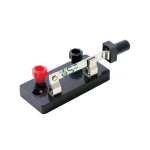
The Telegraph Key by Scientifc Equipment is a practical classroom apparatus used to explain how early electrical communication systems worked. It generally consists of a lever, contact points, spring return mechanism, adjustment screw, terminals, and a stable base arrangement as per the supplied model configuration.
When the lever is pressed, the metal contact closes the circuit and sends an electrical signal. When the lever is released, the spring opens the circuit and stops the signal. This make-and-break action allows students to create controlled electrical pulses for Morse code experiments and simple signalling circuits.
This apparatus is useful for teaching electricity, communication systems, open and closed circuits, switches, coded signals, electrical pulses, and STEM-based problem solving. It connects physics, electronics, and communication history through hands-on classroom learning.
Key Features
- Brand: Scientifc Equipment
- Educational Telegraph Apparatus: Designed for demonstrating Morse code and electrical signalling.
- Manual Switch Operation: Completes and breaks the circuit when pressed and released.
- Dot and Dash Signalling: Supports short and long electrical pulses for Morse code practice.
- Physics Lab Suitable: Useful for electricity, circuits, communication, and STEM activities.
- Adjustable Contact Design: Allows clear demonstration of make-and-break circuit action as per model configuration.
- Reusable Apparatus: Suitable for repeated classroom demonstrations and student practicals.
- Hands-On Learning Tool: Helps students understand switches, current flow, and coded communication.
Product Specifications
|
Product Name |
Telegraph Key |
|
Brand |
Scientifc Equipment |
|
Product Type |
Educational telegraph and Morse code signalling apparatus |
|
Primary Use |
Demonstrating Morse code, electrical signalling, and switch-based circuit operation |
|
Working Principle |
Manual make-and-break contact completes and interrupts an electrical circuit |
|
Main Components |
Lever key, contact points, spring return, adjustment screw, terminals, and base as per supplied model configuration |
|
Power Source |
Suitable low-voltage battery or DC power supply as per experiment requirement |
|
Connection Type |
Terminals for connecting wires, buzzer, sounder, lamp, or signalling circuit |
|
Subject Use |
Physics, electricity, electronics, communication, general science, and STEM education |
|
Demonstration Topics |
Morse code, telegraph communication, open circuit, closed circuit, current flow, switch operation, electrical pulses, and coded signals |
|
Application |
Classroom demonstrations, school practicals, STEM activities, electronics projects, communication experiments, and science fair models |
|
Suitable For |
Schools, colleges, physics laboratories, STEM labs, electronics classrooms, and educational institutions |
|
Usage Mode |
Teacher-led demonstration and supervised student practical use |
|
Packaging |
Standard educational laboratory supply packaging |
How to Use Telegraph Key
- Place the telegraph key on a clean, dry, and stable laboratory table.
- Connect one terminal of the telegraph key to a suitable low-voltage battery or DC power source.
- Connect the second terminal to a buzzer, sounder, lamp, or suitable signalling device.
- Complete the circuit by connecting the remaining terminal of the signalling device back to the power source.
- Check all connections before operating the circuit.
- Press the key briefly to create a short signal, known as a dot.
- Press the key for a slightly longer duration to create a long signal, known as a dash.
- Use dot and dash combinations to form letters and numbers according to a Morse code chart.
- Ask students to send and decode simple messages during classroom practice.
- After use, disconnect the power source and store the apparatus safely in a dry place.
Educational Applications
- Demonstrating Morse code communication
- Teaching open and closed circuit concepts
- Explaining manual switch operation in electrical circuits
- Showing how electrical pulses can transmit coded messages
- Introducing students to historical telegraph communication systems
- Using with buzzers, lamps, sounders, and simple circuit kits
- Supporting STEM activities, electronics projects, and science fair models
- Encouraging practical learning of circuits, signals, timing, and decoding
Why Choose Scientifc Equipment Telegraph Key?
Scientifc Equipment provides practical educational science apparatus designed for classroom demonstrations, laboratory learning, and STEM-based activities. The Telegraph Key helps students understand how simple electrical circuits can be used for communication and coded signalling.
- Suitable for school and college science laboratories
- Useful for physics, electronics, and communication demonstrations
- Simple working design for clear classroom explanation
- Helps students learn current flow and switch operation through hands-on use
- Supports Morse code practice, STEM activities, and project-based learning
- Suitable for institutional procurement and science lab setup
Care and Safety Instructions
- Use the telegraph key only under teacher or laboratory instructor supervision.
- Use only a suitable low-voltage battery or approved educational DC power source.
- Do not connect the apparatus directly to mains electricity.
- Check wires, terminals, and contact points before operating the circuit.
- Avoid short circuits by connecting components correctly.
- Do not press the lever with excessive force.
- Keep the apparatus away from water, moisture, dust, and corrosive chemicals.
- Disconnect the power source after completing the experiment.
- Store the telegraph key in a clean and dry laboratory cabinet after use.
SEO Title
Telegraph Key for Morse Code Experiments – Scientifc Equipment
Meta Description
Buy Scientifc Equipment Telegraph Key for school science labs, STEM classrooms, Morse code experiments, electrical signalling, simple circuit demonstrations, and communication practicals.
SEO Keywords
Telegraph Key, Scientifc Equipment Telegraph Key, Morse Code Telegraph Key, School Telegraph Apparatus, Physics Lab Telegraph Key, Electrical Signalling Key, STEM Communication Kit, Morse Code Experiment Apparatus, Simple Circuit Switch, Science Lab Telegraph Model.
FAQ – Telegraph Key
- What is a Telegraph Key used for?
A Telegraph Key is used to demonstrate Morse code signalling, simple circuit switching, electrical pulses, and coded communication in science and electronics experiments.
- Is this product suitable for school laboratories?
Yes, Scientifc Equipment Telegraph Key is suitable for school science labs, physics practicals, STEM classrooms, electronics lessons, and supervised student activities.
- How does a Telegraph Key work?
A Telegraph Key works as a manual switch. When pressed, it closes the circuit and sends a signal. When released, it opens the circuit and stops the signal.
- Can it be used for Morse code practice?
Yes, short presses can be used as dots and longer presses can be used as dashes to create Morse code letters, numbers, and simple messages.
- What components can be connected with a Telegraph Key?
It can be connected with a low-voltage battery, buzzer, sounder, lamp, LED, connecting wires, and other suitable educational circuit components.
- What power source is required?
A suitable low-voltage battery or DC power supply should be used as per the experiment requirement. The apparatus should never be connected directly to mains electricity.
- Can students operate the Telegraph Key?
Yes, students can operate it under teacher or laboratory instructor supervision using safe low-voltage circuit connections.
- Which concepts can be taught using this apparatus?
This apparatus can teach open and closed circuits, switch operation, current flow, electrical signalling, Morse code, coded communication, and basic electronics.
- How should the Telegraph Key be maintained?
Keep the key clean and dry, check terminals and contact points regularly, avoid excessive force on the lever, and store it safely after use.
- Is this product useful for STEM education?
Yes, it supports STEM education by helping students build simple signalling circuits, send coded messages, and understand the connection between electricity and communication.
Conclusion
Scientifc Equipment Telegraph Key is a practical educational apparatus for teaching Morse code, electrical signalling, current flow, switch operation, and simple communication circuits. Its hands-on working design makes it suitable for school laboratories, STEM classrooms, physics practicals, electronics activities, science fair models, and institutional science lab setups.
.jpg)
.jpg)
.jpg)
.jpg)
.jpg)