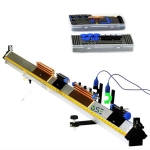
Thermoelectric Demonstrator Manufacturer,Supplier and Exporter in India
.jpg)
Product Code : SCL-PLE-11948
The Thermoelectric Demonstrator by Scientifc Equipment is an educational physics laboratory apparatus designed to help students understand thermoelectric effect, heat energy conversion, temperature difference, electric current generation, Seebeck effect, Peltier effect, energy transfer, and renewable energy concepts. It is suitable for school physics laboratories, college science labs, STEM classrooms, electronics lessons, heat transfer demonstrations, teacher-led practicals, and supervised student laboratory work.
This apparatus provides a practical way to demonstrate how a temperature difference across suitable materials can produce electrical output, or how electrical input may create heating and cooling effects depending on model configuration. It helps students connect heat, electricity, and energy conversion through direct observation and measurement.
Product Description
A thermoelectric demonstrator is used to show the relationship between thermal energy and electrical energy. In a typical demonstration, one side of the thermoelectric element is heated while the other side is kept cooler, producing a small voltage due to the Seebeck effect. Some models may also demonstrate cooling or heating when current is supplied through the module, illustrating the Peltier effect.
The Scientifc Equipment Thermoelectric Demonstrator may include a thermoelectric module, heat sink, hot and cold plates, connecting terminals, thermometer ports, LED or small motor load, low-voltage input leads, base board, activity sheet, and instruction guide depending on product configuration. It is designed for supervised educational and laboratory demonstration use only.
Key Features
- Educational apparatus for demonstrating thermoelectric energy conversion.
- Helps explain Seebeck effect, Peltier effect, temperature difference, voltage, and current.
- Useful for heat transfer, energy conversion, electricity, and renewable energy lessons.
- May show electrical output from heating and cooling difference depending on configuration.
- May include thermoelectric module, heat sink, terminals, load accessories, and activity guide.
- Suitable for physics labs, electronics classrooms, STEM labs, and science exhibitions.
- Supports voltage, current, temperature, and load response measurement activities.
- Encourages observation, prediction, measurement, graphing, calculation, and scientific reasoning.
- Designed for supervised educational laboratory use only.
Product Specifications
|
Product Name |
Thermoelectric Demonstrator |
|
Brand |
Scientifc Equipment |
|
Product Type |
Educational Thermoelectric Effect and Energy Conversion Demonstration Apparatus |
|
Application |
Thermoelectric Effect Demonstration, Seebeck Effect Study, Peltier Effect Activity, Heat Transfer Experiment, Energy Conversion Practical, STEM Learning, and Classroom Teaching |
|
Working Principle |
A Temperature Difference Across a Thermoelectric Module Can Produce Electrical Output, While Electrical Input May Produce Heating and Cooling Effects Depending on Configuration |
|
Possible Components |
Thermoelectric Module, Hot Plate, Cold Plate, Heat Sink, Connecting Terminals, LED or Motor Load, Temperature Sensors, Thermometer Ports, Base Board, Activity Sheet, and Instruction Guide Depending on Product Configuration |
|
Possible Material |
Thermoelectric Semiconductor Module, Aluminium Heat Sink, Metal Plates, Insulated Wiring, Plastic or Wooden Base, Electrical Terminals, and Educational-Grade Laboratory Materials Depending on Model Design |
|
Demonstration Type |
Seebeck Effect, Peltier Effect, Heat-to-Electricity Conversion, Electrical-to-Heat Transfer, Temperature Gradient Observation, Voltage Generation, and Load Operation |
|
Measurement Type |
Temperature Difference, Output Voltage, Output Current, Load Response, Heating Effect, Cooling Effect, Time Response, and Qualitative Energy Conversion Observation Depending on Setup |
|
Power Requirement |
Heat Source, Cold Source, Battery, Adapter, or Low-Voltage Educational Power Supply Depending on Demonstration Mode and Product Configuration |
|
Compatible Accessories |
Thermometer, Digital Temperature Sensor, Multimeter, Low-Voltage Power Supply, LED, Small DC Motor, Beaker of Warm Water, Ice Pack, Stopwatch, Activity Sheet, Graph Paper, Calculator, and Physics Practical Notebook |
|
Educational Use |
Physics Lesson, Heat Transfer Demonstration, Electronics Practical, Renewable Energy Activity, STEM Project, and Student Laboratory Work |
|
Suitable For |
Schools, Colleges, Physics Laboratories, Electronics Labs, STEM Labs, Science Rooms, Teacher Training Centers, Science Clubs, and Educational Institutions |
|
Learning Topics |
Thermoelectric Effect, Seebeck Effect, Peltier Effect, Heat Transfer, Temperature Difference, Voltage, Current, Energy Conversion, Electricity, and Sustainable Technology |
|
Operation |
Manual Setup, Heat and Cold Source Application, Electrical Connection, Output Measurement, Load Testing, Observation, Result Recording, and Supervised Laboratory Demonstration |
|
Important Note |
For Educational and Laboratory Demonstration Use Only; Module Rating, Heat Sink Design, Power Input, Temperature Range, Accessories, and Construction Depend on Product Configuration |
How to Use
- Place the Thermoelectric Demonstrator on a stable, clean, dry, and level laboratory bench.
- Inspect the thermoelectric module, heat sink, terminals, wires, plates, sensors, and accessories before use.
- Set up the apparatus according to the teacher’s instruction or supplied activity guide.
- For Seebeck effect demonstration, apply a safe warm source to one side and a cool source to the opposite side if the model allows.
- Connect a multimeter to the output terminals to observe voltage or current.
- Connect a small approved load such as an LED or mini motor if included and compatible.
- Observe how output changes as the temperature difference changes.
- For Peltier effect demonstration, connect only the recommended low-voltage power supply if the model supports powered operation.
- Observe heating and cooling effects carefully without touching hot surfaces.
- Record temperature, voltage, current, time, and load response in the practical notebook.
- Repeat the experiment by changing one variable at a time, such as temperature difference or load type.
- Discuss how thermal energy and electrical energy are connected through thermoelectric effects.
- Switch off power, remove heat and cold sources, allow parts to return to safe temperature, and store the apparatus properly.
Safety and Handling Instructions
- Use only under teacher, laboratory instructor, or trained adult supervision.
- Use only safe, teacher-approved heat and cold sources.
- Do not touch hot plates, heated surfaces, or cooled surfaces directly during or immediately after use.
- Wear safety goggles and heat-resistant gloves if recommended by the activity guide.
- Use only the recommended low-voltage power supply if electrical input is required.
- Do not connect the apparatus directly to mains electricity unless specifically rated and approved.
- Switch off power before changing wiring, loads, sensors, or accessories.
- Keep water, ice, and condensation away from electrical terminals and power supplies unless the setup is specifically designed for that use.
- Do not short-circuit output terminals, input leads, or connected loads.
- Do not overheat the thermoelectric module or exceed the recommended temperature range.
- Do not use damaged wires, cracked modules, loose terminals, broken plates, faulty sensors, or exposed conductors.
- Allow all parts to cool or return to safe temperature before handling or storage.
- Store the apparatus in a clean, dry, and protective place after use.
Educational Applications
- Demonstrating the Seebeck effect by producing electricity from a temperature difference.
- Explaining the Peltier effect using electrical input and heat transfer if supported by the model.
- Studying voltage and current output from thermoelectric conversion.
- Investigating the effect of temperature difference on electrical output.
- Teaching heat transfer, energy conversion, and sustainable technology concepts.
- Supporting STEM projects, renewable energy activities, and electronics lessons.
- Useful for physics practicals, science exhibitions, and classroom demonstrations.
- Encouraging observation, measurement, graphing, comparison, calculation, and scientific reasoning.
Why Choose Scientifc Equipment Thermoelectric Demonstrator?
The Scientifc Equipment Thermoelectric Demonstrator provides a clear and practical way to teach the connection between heat and electricity. Its classroom-friendly design supports hands-on demonstrations of thermoelectric effects, energy conversion, and temperature-based electrical output in a supervised educational environment.
FAQ
- What is the Thermoelectric Demonstrator used for?
It is used to demonstrate thermoelectric effect, Seebeck effect, Peltier effect, temperature difference, voltage generation, heat transfer, and energy conversion concepts.
- Is this apparatus suitable for school physics laboratories?
Yes, it is suitable for school physics labs, college science labs, electronics classrooms, STEM labs, renewable energy lessons, and supervised practical activities.
- How does a thermoelectric demonstrator work?
It works by using a thermoelectric module. A temperature difference across the module can produce electrical output, while electrical input may create heating and cooling effects depending on configuration.
- Does the Thermoelectric Demonstrator require electricity?
It may not require electricity for basic Seebeck effect demonstrations, but a low-voltage educational power supply may be required for Peltier effect demonstrations depending on product configuration.
- What can students measure with this apparatus?
Students can measure temperature difference, voltage, current, load response, time response, heating effect, cooling effect, and energy conversion behaviour depending on the setup.
- Can it power an LED or small motor?
Some configurations may power a small LED or mini motor when sufficient temperature difference is created. Load compatibility depends on the module output and product design.
- Can students use the Thermoelectric Demonstrator independently?
Students should use it under teacher or trained adult supervision because it may involve heated surfaces, cold sources, low-voltage circuits, and measurement instruments.
- How should the Thermoelectric Demonstrator be stored?
Remove heat and cold sources, switch off and disconnect electrical connections if used, allow all parts to return to safe temperature, clean and dry the apparatus, and store it in a clean, dry, protective place away from moisture, dust, heat, chemicals, impact, and rough handling.
SEO Keywords
Thermoelectric Demonstrator, Scientifc Equipment Thermoelectric Demonstrator, educational thermoelectric apparatus, Seebeck effect demonstrator, Peltier effect demonstration kit, school physics thermoelectric model, heat to electricity apparatus, temperature difference voltage experiment, STEM energy conversion kit, thermoelectric module demonstration, renewable energy teaching aid, physics lab heat transfer apparatus.
SEO Meta Title
Thermoelectric Demonstrator – Scientifc Equipment
SEO Meta Description
Buy Thermoelectric Demonstrator by Scientifc Equipment for school physics labs, Seebeck effect experiments, Peltier effect demonstrations, heat transfer lessons, voltage measurement, renewable energy activities, and supervised STEM learning.
Google E-E-A-T Focused Content
This product content is prepared to support teachers, school buyers, laboratory suppliers, physics educators, STEM coordinators, electronics instructors, renewable energy teachers, lab technicians, students, and educational institutions with clear product information, practical specifications, usage guidance, safety instructions, and helpful FAQs. The content focuses on accurate educational thermoelectric applications, supervised Thermoelectric Demonstrator use, safe handling of heat sources, cold sources, low-voltage circuits, and measurement instruments, energy conversion learning, Seebeck and Peltier effect observation, and trustworthy product guidance while clearly stating that the product is for educational and laboratory demonstration use only.
.jpg)
.jpg)
.jpg)
.jpg)
.jpg)
.jpg)