Low Temperature Difference Stirling Engine Manufacturer,Supplier and Exporter in India
.jpg)
Product Code : SCL-PLE-11312
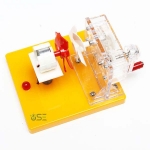
Scientifc Equipment Low Temperature Difference Stirling Engine is an educational thermodynamics demonstration model designed to show how a small temperature difference can be converted into mechanical motion. It is widely used in physics laboratories, STEM classrooms, engineering demonstrations, and science exhibitions to explain heat engines, energy conversion, thermal expansion, and the working principle of Stirling engines.
This model helps students understand how heat energy can produce motion without internal combustion. It operates using a temperature difference between two surfaces, making it a safe and engaging apparatus for classroom demonstrations of thermodynamics and renewable energy concepts.
Product Description
The Low Temperature Difference Stirling Engine by Scientifc Equipment is a practical educational apparatus used to demonstrate the conversion of thermal energy into mechanical energy. Unlike high-temperature heat engines, this model can operate with a relatively small temperature difference, such as warmth from a hot cup, warm water, or a heated surface, depending on the model configuration.
The engine works on the Stirling cycle principle, where air inside the engine expands and contracts due to temperature variation. This movement drives the piston and flywheel, allowing students to observe mechanical motion generated from heat energy. The apparatus is useful for explaining thermal expansion, heat transfer, pressure variation, work output, and energy transformation.
Scientifc Equipment Low Temperature Difference Stirling Engine is suitable for school physics labs, college laboratories, STEM education programs, science fairs, and introductory engineering demonstrations.
Key Features
- Brand: Scientifc Equipment
- Thermodynamics Demonstration Model: Designed to explain heat-to-motion energy conversion.
- Low Temperature Operation: Demonstrates motion using a small temperature difference.
- Visible Working Mechanism: Allows students to observe piston and flywheel movement clearly.
- STEM Learning Tool: Suitable for physics, engineering, and energy science education.
- Classroom Friendly: Useful for teacher-led demonstrations and supervised student activities.
- Reusable Apparatus: Suitable for repeated laboratory and classroom use.
- Concept-Based Learning: Helps explain heat engines, thermal expansion, and energy transformation.
Product Specifications
|
Product Name |
Low Temperature Difference Stirling Engine |
|
Brand |
Scientifc Equipment |
|
Product Type |
Educational thermodynamics demonstration apparatus |
|
Working Principle |
Conversion of heat energy into mechanical motion using the Stirling cycle |
|
Subject Use |
Physics, thermodynamics, energy conversion, STEM education, engineering basics |
|
Main Components |
Base plate, displacer piston, power piston, flywheel, connecting rod, cylinder, and support frame as per model design |
|
Operation Type |
Low temperature difference heat engine demonstration |
|
Heat Source |
Warm surface, hot water container, or suitable low-temperature heat source as per model configuration |
|
Demonstration Topics |
Stirling engine principle, heat transfer, thermal expansion, pressure change, mechanical work, energy conversion |
|
Application |
Physics practicals, STEM activities, classroom demonstrations, science exhibitions, engineering learning |
|
Suitable For |
Schools, colleges, STEM labs, physics laboratories, and educational institutions |
|
Usage Mode |
Teacher-led demonstration and supervised student observation |
|
Packaging |
Standard educational laboratory supply packaging |
How to Use Low Temperature Difference Stirling Engine
- Place the Stirling engine on a flat and stable surface.
- Prepare a suitable low-temperature heat source, such as a warm surface or hot water container.
- Position the engine correctly so that the bottom plate receives heat evenly.
- Allow a temperature difference to develop between the warm and cool sides of the engine.
- Gently rotate the flywheel by hand to start the motion, if required.
- Observe the movement of the piston, connecting rod, and flywheel.
- Explain how air inside the engine expands and contracts due to temperature changes.
- Discuss how heat energy is converted into mechanical motion.
- After the demonstration, remove the heat source and allow the engine to cool.
- Store the apparatus safely in a dry place after use.
Educational Applications
- Demonstrating the working principle of Stirling engines
- Explaining conversion of thermal energy into mechanical energy
- Teaching thermodynamics and heat engine concepts
- Showing thermal expansion and contraction of air
- Demonstrating the effect of temperature difference on engine motion
- Introducing renewable energy and external combustion engine concepts
- Supporting STEM-based classroom learning and science exhibitions
- Helping students connect theoretical physics with real mechanical motion
Why Choose Scientifc Equipment Low Temperature Difference Stirling Engine?
Scientifc Equipment provides educational science apparatus designed for practical learning, classroom demonstration, and STEM education. The Low Temperature Difference Stirling Engine helps teachers present thermodynamics concepts in a visual, interactive, and observation-based format.
- Suitable for school and college physics laboratories
- Supports hands-on learning of heat engines and thermodynamics
- Useful for STEM projects and science demonstrations
- Helps students understand energy conversion through visible motion
- Ideal for science exhibitions, engineering basics, and classroom practicals
- Suitable for institutional procurement and laboratory setup
Care and Safety Instructions
- Use the apparatus only under teacher or laboratory instructor supervision.
- Do not use an open flame unless the model is specifically designed for it.
- Use only a suitable low-temperature heat source recommended for classroom demonstrations.
- Allow the engine to cool before handling after use.
- Do not apply excessive force to the flywheel, piston, or connecting rod.
- Keep the moving parts clean and free from dust.
- Avoid dropping the apparatus or placing heavy objects on it.
- Store the model in a dry and safe place after use.
SEO Title
Low Temperature Difference Stirling Engine – Scientifc Equipment
Meta Description
Buy Scientifc Equipment Low Temperature Difference Stirling Engine for physics labs, STEM classrooms, thermodynamics demonstrations, heat engine experiments, and science projects.
SEO Keywords
Low Temperature Difference Stirling Engine, Scientifc Equipment Stirling Engine, LTD Stirling Engine Model, Physics Lab Stirling Engine, Thermodynamics Demonstration Apparatus, Heat Engine Model for School Lab, STEM Stirling Engine Kit, Energy Conversion Demonstration Model, External Combustion Engine Model, Science Lab Thermodynamics Equipment.
FAQ – Low Temperature Difference Stirling Engine
- What is a Low Temperature Difference Stirling Engine used for?
A Low Temperature Difference Stirling Engine is used to demonstrate how heat energy can be converted into mechanical motion using a small temperature difference. It is commonly used in physics labs and STEM classrooms.
- Is this product suitable for school physics laboratories?
Yes, Scientifc Equipment Low Temperature Difference Stirling Engine is suitable for school physics labs, college laboratories, STEM classrooms, science fairs, and teacher-led demonstrations.
- How does a Stirling engine work?
A Stirling engine works by heating and cooling air inside the engine. As the air expands and contracts, it moves the piston and drives the flywheel, converting thermal energy into mechanical motion.
- Does this model require an open flame?
Low Temperature Difference Stirling Engine models generally work with a small temperature difference and may not require an open flame. Use only the heat source recommended for the specific model supplied.
- Which concepts can be taught using this apparatus?
This apparatus can be used to teach thermodynamics, heat transfer, thermal expansion, pressure change, energy conversion, mechanical work, and heat engine principles.
- Can students operate this model?
Students can observe and operate the model under teacher or laboratory instructor supervision. The moving parts should be handled carefully.
- Why is it called a low temperature difference engine?
It is called a low temperature difference engine because it can operate using a relatively small temperature difference between the warm and cool sides of the engine.
- How should the Stirling engine be maintained?
Keep the model clean, avoid dust on moving parts, do not force the flywheel or piston, and store it in a dry place after use.
Conclusion
Scientifc Equipment Low Temperature Difference Stirling Engine is an effective educational apparatus for demonstrating thermodynamics, heat engine principles, and energy conversion. It helps students observe how a temperature difference can create mechanical motion, making it a valuable teaching aid for physics laboratories, STEM classrooms, engineering demonstrations, and science exhibitions.
.jpg)
.jpg)
.jpg)
.png)
.jpeg)